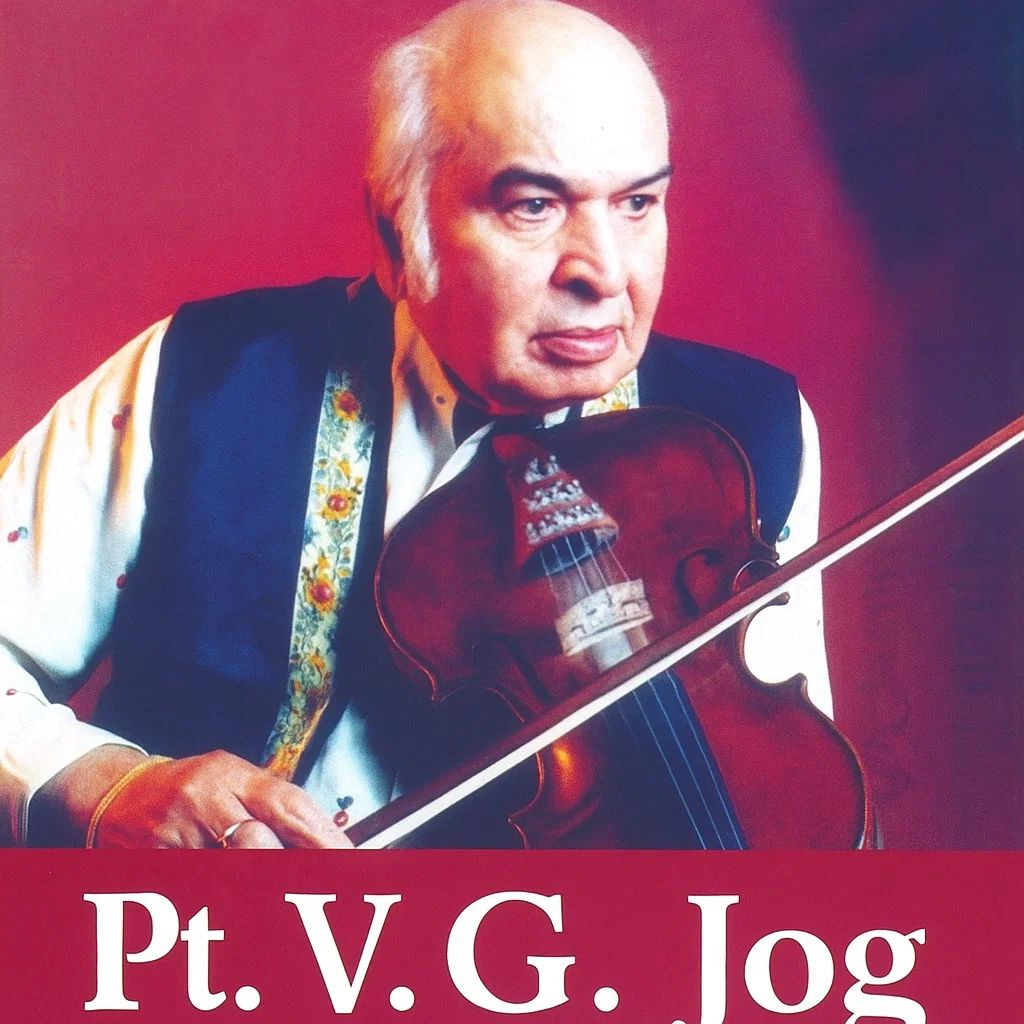
Padmabhushan Pt. V. G. Jog
Pandit V. G. Jog – The Architect of Hindustani Violin
Few musicians in the history of Hindustani classical music have shaped an instrument as profoundly as Pandit Vishnu Govind Jog. His work not only brought the Western violin into the core of the Hindustani classical tradition but also established a completely indigenous, uniquely Indian idiom of violin playing. Today, every Hindustani violinist—directly or indirectly—draws from the foundations laid by him.
Born in 1922, trained under great masters, and performing for over six decades, Pt. V. G. Jog occupies a towering place in Indian music—a pioneer, an innovator, a scholar, and a torchbearer of gayaki as well as tantrakari on the violin.
Early Life and Gurus
Pt. Jog was trained under some of the most formidable stalwarts of the 20th century:
1. Pt. S. N. Ratanjankar
A monumental figure of the Gwalior–Agra lineage, Ratanjankar imparted rigorous training in:
- Raga grammar
- Laykari
- Dhrupad-Dhamar structure
- Precision of swara
- Compositional discipline
Pandit ji absorbed a deep theoretical grounding which later shaped his composed, intellectual style of playing.
2. Ustad Allauddin Khan (Baba Allauddin Khan), Maihar
Training under Baba Allauddin Khan exposed him to:
- Complex instrumental techniques
- String instrument science
- Cross-gayana influences
- Intricate taans, tihais
- Multi-instrumental understanding
This blend of Gwalior–Agra vocalism and Maihar instrumentalism became Pandit’s hallmark.
Contribution: The Man Who Gave Hindustani Music Its Own Violin Idiom
Before Pt. Jog, the violin was not a primary Hindustani instrument. It existed in accompaniment but lacked a codified technique and identity.
His achievements include:
1. Developing an indigenous Hindustani violin style
Pandit ji was the first to systematize:
- Bowing suited to meend, kan, gamak
- Fingering patterns for long glides
- Shruti-rich intonation
- Gamak-based taans
- Paltas and alankars specifically for violin
2. Establishing violin as a solo concert instrument
He elevated the violin from a marginal role to a central solo medium on par with sitar, sarod, shehnai, and vocal music.
3. Creating the unique “Jawari Violin”
Pandit ji also introduced innovations in violin construction including:
- 5th main string
- 7–11 sympathetic (tarab) strings
- A resonant bridge inspired by jawari of sitar
- Modified body size
- Enhanced depth and sustain
This gave the violin a Hindustani resonance, allowing it to speak the language of raga naturally.
4. Codifying violin pedagogy
His book “Behala Shiksha” became the foundational text for Hindustani violinists.
Tuning Style and Technical Innovations
Pt. Jog’s tuning system differed from Carnatic tuning or Western violin defaults.
Standard Jog Tuning (Main Strings)
P – S – P – á¹ (Pa – Sa – Pa – Upper Sa)
This gave:
- A drone-like stability
- Perfect symmetry for meend
- Ease for ati-komal/ati-tivra inflections
- Resonance akin to tanpura
Preferred Scales
He often tuned the violin to:
- D or D♯ for maximum warmth
- Adjusted the pitch according to tabla, sarangi, or vocalist in accompaniment
Bowing Style
Pandit ji’s bowing combined:
- Vocal meend (smooth, continuous)
- Dhrupad-inspired gamaks
- Slow, weighty long-bow alaaps
- Crystal-clear, staccato taans
The balance of lyrical and percussive articulation became his signature.
Western Violin in Hindustani Music – Pt. Jog’s Historic Role
Although the violin came to India via the West, it became fully Indianized only through musicians like Pt. Jog.
He adapted the violin to:
- Indian microtonal scale (shrutis)
- Free-flowing meend
- Complex taans
- Raga architecture
- Laya progression
- Tanpura-based resonance
His efforts made violin a natural Hindustani voice, not an imported instrument.
The Art of Accompaniment
Pt. Jog was also among the finest violin accompanists, partnering legendary vocalists such as:
- Ustad Faiyaz Khan
- Pt. Omkarnath Thakur
- Ustad Bade Ghulam Ali Khan
- Ustad Amir Khan
- Kesarbai Kerkar
- Begum Akhtar
- Hirabai Barodekar
His accompaniment style was:
- Transparent and supportive
- Never intrusive
- Filled with intelligent fillers and melodic responses
- Sensitive to vocalist’s mood
- Rich in shruti, raga bhaava, and layakari
Vocalists trusted him completely because he never overshadowed; he enhanced.
Presentation of Raga
Jog’s raga vistar was marked by:
1. Deep Grammar and Precision
His training under Ratanjankar ensured uncompromising adherence to raga lakshan.
2. Structured, Slow Gradation
From vilambit alaap to drut taan, everything had architecture, not ornamentation alone.
3. Blend of Gayaki and Tantrakari
Rarely balanced by violinists, Jog achieved a near-perfect combination of both.
4. Crystal-clear Swara Shuddhi
Despite complex meends, every note emerged clean and deliberate.
5. Command Over Layakari
Especially in:
- Sam-oriented tihais
- Sapat taans
- Vakra movements
His performances carried both intellectual depth and emotional charge.
Music Philosophy
Pandit Jog believed:
1. Music is a Language of Truth
A note is either correct or not — there is no middle path.
2. Raga Should Blossom Naturally
A raga must be unfolded with patience, like “opening a flower petal by petal.”
3. Technique Serves Emotion
While he was a master technician, he used technique only to reveal bhaava, not to show virtuosity.
4. Precision is Spiritual
He considered swara shuddhi a form of devotion — a sadhana.
Legacy and Influence
Pt. V. G. Jog’s impact is seen in:
- Nearly all modern Hindustani violinists
- His disciples in India and abroad
- The jawari violin construction
- Pedagogy (Behala Shiksha)
- His consistent presence in music festivals and recordings
- His collaborations with Ravi Shankar, Ali Akbar Khan, Hariprasad Chaurasia, etc.
He gave Hindustani music a violin personality that endures today.
Financial Difficulties and Final Years
Despite being a colossus of Indian music, Pt. Jog’s last years were marked by hardship.
- Starting around 1999, V. G. Jog was reportedly diagnosed with Parkinson’s disease.
- Treatment costs were high, and like many classical musicians of his era, he had limited financial planning and institutional support.
- He struggled to manage household and medical expenses.
- The music community organized support concerts to help him in his final years.
- His passing in 2004 highlighted the urgent need for financial security schemes for classical musicians, something still lacking even today.
Pt. Jog’s life is both an inspiration and a reminder of how society must support its great artists.
Conclusion
Pandit V. G. Jog was not merely a violinist—he was an institution, a philosopher of sound, a technical innovator, and one of the greatest minds in Hindustani classical music.
His work turned the violin into a truly Indian voice, rich in raga, emotion, philosophy, and tradition. His legacy continues to guide musicians, scholars, and listeners, reminding us that true greatness lies in dedication, humility, and the lifelong pursuit of musical truth.
References
https://worldmusiccentral.org/renowned-violinist-v-g-jog-passes-away/?utm_source=chatgpt.com
https://www.britannica.com/biography/V-G-Jog?utm_source=chatgpt.com
https://kenhunt.doruzka.com/index.php/v-g-jog-1922-2004/?utm_source=chatgpt.com
https://darbar.org/pandit-v-g-jog/?utm_source=chatgpt.com
https://vgjogfound.org/?utm_source=chatgpt.com