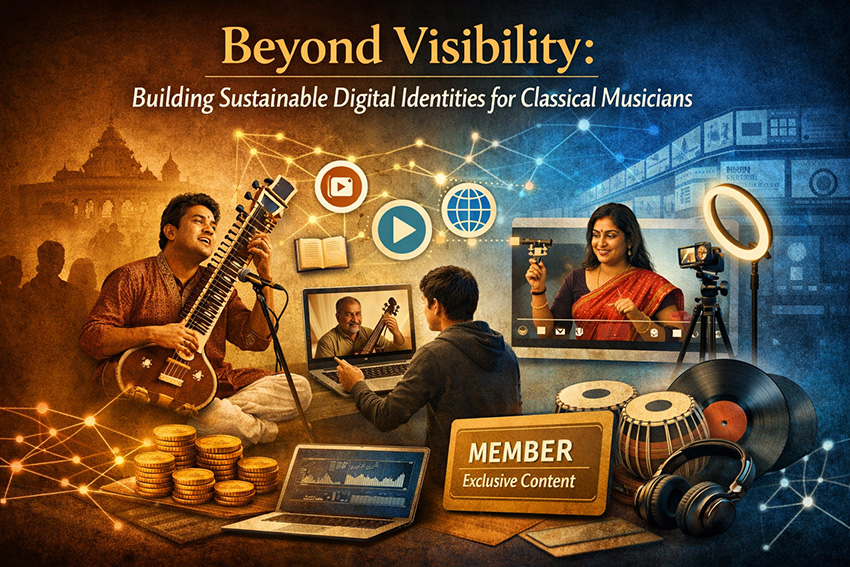
Beyond Visibility: Building Sustainable Digital Identities for Classical Musicians
The digital era has brought unprecedented visibility to Indian Classical Music.
A musician today can upload a performance and potentially reach listeners across continents within hours. Streaming platforms and social media have significantly lowered the barriers that once limited access to concert halls, institutions, or geographical music circuits.
Yet visibility alone does not guarantee sustainability.
For many artists, the digital space has become a paradox. While recordings may attract listeners globally, the economic return from streaming platforms remains modest. Classical music, with its long-form presentations and nuanced improvisation, does not easily align with systems designed for short-format and high-frequency consumption.
This raises an important question:
How can musicians translate digital visibility into meaningful artistic livelihoods?
One way forward lies in recognizing that streaming is only one element of a much larger Digital Ecosystem.
In earlier eras, ecosystems were relatively simple. The Darbar provided patronage. Broadcast institutions expanded reach. Concert circuits connected artists to audiences. In the digital age, however, the ecosystem has become layered and interconnected.
Artists now have opportunities to engage with listeners through multiple channels simultaneously.
Online teaching has already emerged as one such avenue. Digital classrooms have enabled students from different parts of the world to learn directly from masters without geographical constraints. For many musicians, pedagogy is becoming an important pillar of sustainability in the digital age.
Equally significant is the creation of curated digital archives. Recordings, lecture demonstrations, and raga explorations can gradually evolve into structured repositories of knowledge. Such archives not only preserve artistic work but also create long-term value for both scholars and listeners.
Community-based digital engagement is another emerging dimension. Membership platforms, interactive listening sessions, and curated online baithaks allow artists to develop deeper relationships with audiences who value classical traditions.
In essence, the digital identity of a musician today can extend far beyond performance alone. It can include the roles of performer, teacher, archivist, cultural interpreter, and knowledge custodian.
The challenge, therefore, is not merely to adapt to technology but to shape how technology serves the art.
Indian Classical Music has always evolved through thoughtful balance — between tradition and innovation, discipline and creativity. The digital era calls for a similar balance, where technological tools are used not to dilute the art but to strengthen the ecosystem that sustains it.
The future may belong to musicians who learn to navigate both worlds — the timeless grammar of the raga and the expanding possibilities of the digital landscape.
In the next article, we will explore how data, metadata, and digital archiving may play a crucial role in preserving and transmitting the knowledge systems embedded within Indian Classical Music.
Read previous article in the series : The Streaming Turn: Democratization, Disruption, and the Economics of Attention
Ratish Tagde, Mumbai
Dr. Ratish Tagde is a classical musician and scholar whose research focuses on the structural transformation of Indian classical music within digital and AI-driven environments. His work addresses questions of authorship, improvisation, and economic sustainability in streaming-based ecosystems, with particular emphasis on ethical data governance for traditional musicians.